
How to Choose a Reliable Chinese Furniture Sourcing Channel

How to Choose a Reliable Chinese Furniture Sourcing Channel
Author-Image
Last Update:  
April 30, 2026

When buying Chinese furniture, the biggest risk is thinking you’ve already figured it out.

You see high-resolution product images, but not the actual leather, foam, or internal frame used in production. You see five-star reviews, but can’t be sure if they come from real buyers. You assume you’ve saved money by cutting out middlemen—only to spend more later on repairs, replacements, or cross-border claims.

Furniture is very different from small consumer goods. It’s bulky and high-value, and once shipped internationally, returns, repairs, or disputes become far more costly and complicated.

On top of that, China’s furniture supply chain is massive. Industry data shows that by 2026, there are over 1 million active furniture-related businesses in China, including around 7,400 manufacturers of notable scale. This vast network brings abundant choices—but also makes filtering the right suppliers much more challenging.

Today, overseas buyers typically follow three main sourcing paths: online platforms, visiting factories or trade shows in person, or working with professional sourcing companies. Each approach has its advantages—and its trade-offs.

1. Online Platforms (e.g., Alibaba, Taobao)

The biggest challenge with online platforms isn’t limited choice—it’s too much choice. A simple search for furniture suppliers on Alibaba can easily return over 5,000 results.While it appears transparent, that transparency often stays on the surface. You can see prices, but not whether materials will be substituted during production. You can read specifications, but not whether they’re truly followed. You can check reviews, but not whether they are genuine or influenced.By 2026, AI-generated images have become highly realistic, allowing sellers to present flawless product visuals that are difficult for buyers to verify.This is also why regulators worldwide are paying closer attention to fake reviews. In 2024, the U.S. FTC introduced rules banning the sale and purchase of false consumer reviews and endorsements, with penalties for violations. This highlights that concerns around online trust are not isolated—they are now part of a broader regulatory focus.
By 2026, AI-generated images have become highly realistic, allowing sellers to present flawless product visuals that are difficult for buyers to verify.This is also why regulators worldwide are paying closer attention to fake reviews. In 2024, the U.S. FTC introduced rules banning the sale and purchase of false consumer reviews and endorsements, with penalties for violations. This highlights that concerns around online trust are not isolated—they are now part of a broader regulatory focus.

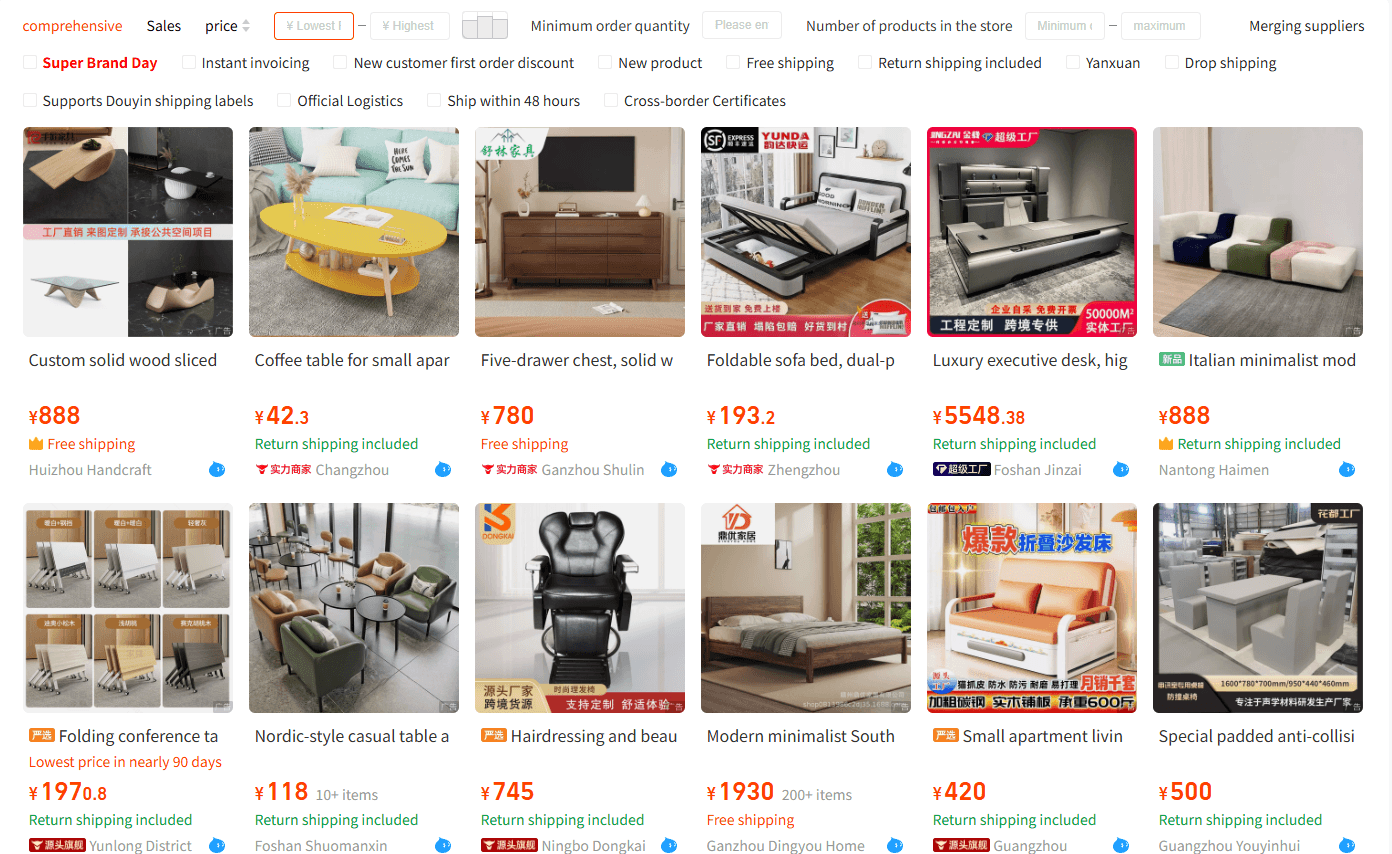
1688 furniture browsing page

So when sourcing furniture on platforms like Alibaba, the key isn’t who has the most polished images or the lowest price—it’s who can stand up to verification.

Start by checking store certifications and repeat purchase rates. Certification means business licenses and production capabilities have been reviewed; a repeat rate above 20% usually indicates consistency in at least one area—quality, delivery, or after-sales.

Next, review the product details. Professional suppliers tend to provide clear specifications—such as foam density or upholstery material—because they have nothing to hide. Vague or missing details are often a red flag.

That said, well-written specs don’t always mean they’re accurate. Many sellers are now skilled at presentation, listing terms like “high-density foam” or “genuine leather feel” in a convincing way. What sets reliable suppliers apart is their willingness to show you how to verify these claims—for example, demonstrating how to press leather and observe its behavior.

Pressed leather texture: real vs. synthetic

One more important point: not every store on online platforms is a factory. Many may look like manufacturers but are actually aggregating products from different factories. If a store sells leather sofas, office chairs, and hardware all at once, it’s likely a trading-style storefront rather than a real factory.

True factories usually focus on one category over the long term. Furniture production involves multiple processes, and it’s unrealistic to handle sofas, lighting, and hardware all at the same level consistently.

A simple way to check is to communicate directly. You can ask: “Can we do a live video call to see the factory now?” If they avoid it or keep postponing, there’s a high chance they’re operating from an office rather than an actual production site.
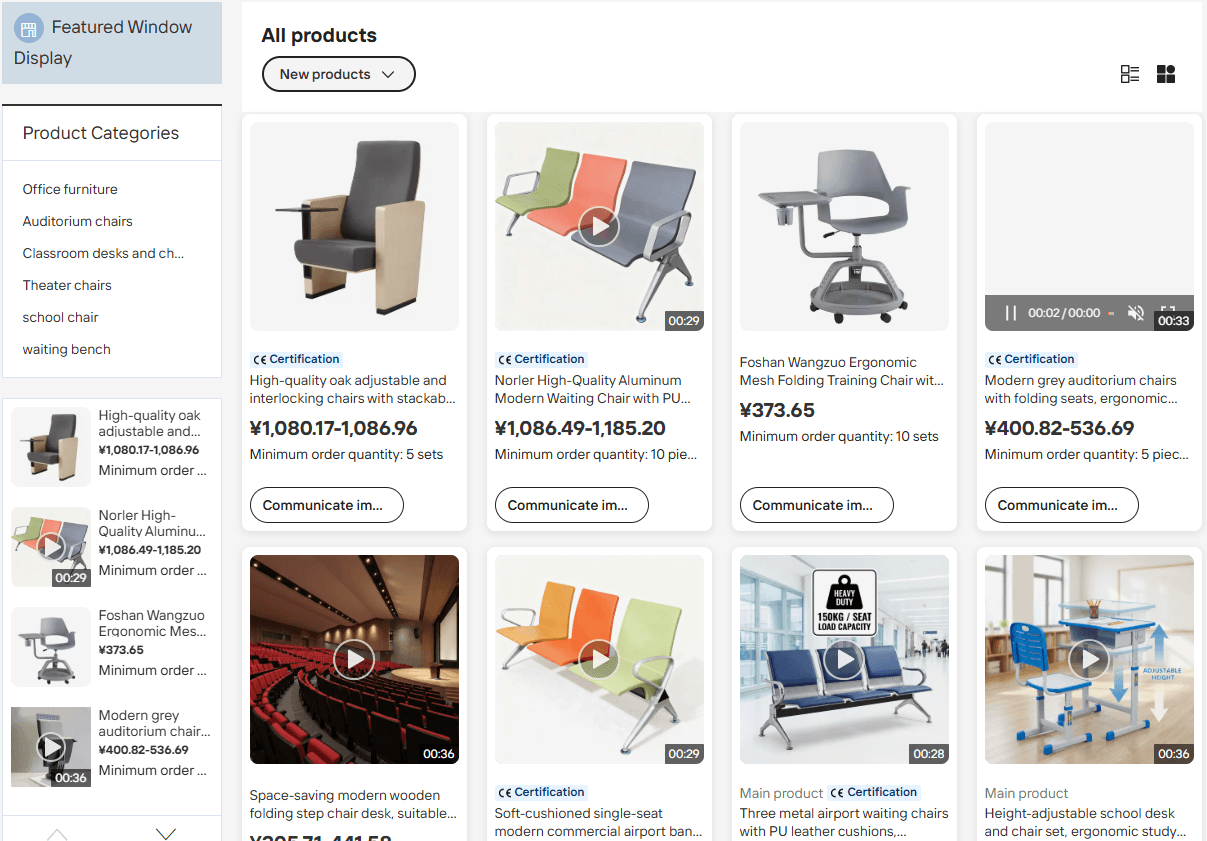
An Alibaba store specializing in chair production

2. Visiting Factories or Trade Shows in Person

If you’re willing to visit China—whether heading to furniture hubs like Foshan, Dongguan, or Zhejiang, or attending large exhibitions like CIFF—you’ll see far more than what online platforms can show.

Take Lecong in Foshan as an example. With nearly 4 million square meters of showroom space and over 180 large furniture malls, the density allows you to explore a wide range of styles, price points, and craftsmanship levels within a single day.

CIFF follows a similar logic. Each year, it brings together around 6,000 leading brands across 750,000 square meters. In essence, it’s a concentrated display of the entire furniture supply chain.

But scale comes with complexity. The more you see, the more judgment is required. The goal isn’t to find just any factory—it’s to identify those that are consistent, professional, and capable of reliable delivery within a vast supplier pool.

The real advantage of visiting in person is bypassing product images and sales pitches. You can directly examine materials, inspect workshops, feel fabrics, test comfort, check hardware quality, and discuss pricing, structure, and lead times face to face.

The lively atmosphere at CIFF Guangzhou

But visiting in person doesn’t automatically mean it’s safe. One of the most common mistakes buyers make is focusing only on the showroom.

Showrooms are carefully staged—lighting is designed, styling is curated, and even product placement is optimized to create a more premium look. What you see there is the version the supplier wants to present.

What truly matters is the materials area, semi-finished section, and production workshop. These spaces have no filters. A factory’s real capability is revealed in these details, not in brochures.

Once inside the workshop, don’t rush to judge how products look. Instead, observe how the operation runs. Are materials organized by category? Are semi-finished items clearly labeled? Do different production steps connect smoothly? These small details directly affect consistency and delivery reliability.

More than surface design, craftsmanship details reveal a factory’s foundation. For panel furniture, check whether edge banding is clean and properly sealed. For sofas, pay attention to what’s hidden—dust covers underneath, or whether the wooden frame has been treated against moisture and pests. If these unseen areas are well-executed, that’s when a factory can be considered truly reliable.

A factory with neatly organized fabric storage

The same applies at trade shows—don’t assume every exhibitor is a factory. You’ll find both manufacturers and well-presented trading companies. Trading companies aren’t necessarily a bad choice, but you need to know who you’re dealing with, as responsibilities, pricing, and after-sales handling differ significantly.

If your goal is to find a factory, start by looking at the product structure on display. Real factories usually focus on a specific category, with products that share clear technical connections. Trading companies, on the other hand, often resemble curated collections—showcasing unrelated items like sofas, beds, lighting, and hardware in one booth to attract a wider audience.

More importantly, observe how they respond to customization requests. Ask specific questions, such as: “Can this joint be changed to a mortise-and-tenon structure?” or “Can this side panel be reduced by 5 cm?”

Many trading companies will quickly say, “Yes, everything is possible,” since they simply pass requests to factories. In contrast, experienced manufacturers won’t respond immediately. They will evaluate structure and stability—and may even tell you directly, “That change isn’t feasible; it would affect load-bearing.”

In furniture sourcing, a supplier willing to say “no” is often more reliable than one who agrees to everything.

Customers negotiating with suppliers at a trade show

3. Sourcing Companies (e.g., Homebridge Team)

If you’re buying just one chair, you may not need a sourcing company. But for a full-home project, the challenge is entirely different. The hardest part isn’t finding a sofa—it’s managing dozens of suppliers at the same time.

A sofa might come from Foshan, a dining set from Dongguan, and a mattress from Huizhou—each factory with its own production timeline and packaging method. Any delay can disrupt the entire container shipment.

Reports show that 21% of buyers of large online purchases have received damaged goods, and 15% reported items never arriving. This highlights the higher logistics risks for bulky items—shipping cannot rely on luck.

This is where sourcing companies add real value. They don’t just help you find lower prices—they turn scattered suppliers into a coordinated, trackable system.

Teams like Homebridge don’t simply sell products on behalf of factories. Their role is to represent the buyer—evaluating which offers may look cheaper but carry higher risks, which designs are unsuitable for long-distance shipping, and which factories can deliver consistently.

Professional furniture sourcing team, Homebridge

Of course, sourcing companies themselves need to be carefully evaluated. Some teams focus on delivering real service, while others simply act as intermediaries earning margins or commissions.

Start with the fee structure. A professional team is transparent about costs—they clearly explain what covers product pricing, logistics, and any potential additional charges. If a company is vague and only promises “the lowest price,” it often leads to budget overruns later.

A strong sourcing team should also have a well-structured and targeted supplier network. You can test this by presenting a specific style requirement and seeing how quickly they match you with suitable factories. If they repeatedly recommend the same few suppliers, they may simply be acting as a basic middleman.

More importantly, pay attention to how they manage supply chain details. Ask how they coordinate inbound timing from different factories or optimize container loading to reduce shipping costs. A mature team—like Homebridge—has a clear understanding of logistics, customs processes, and destination compliance requirements. This level of coordination is difficult to achieve without experience.

Sourcing team integrating factory resources

4.How to Choose the Right Sourcing Approach

Online platforms like Alibaba remain the most common option. However, there’s a growing reality: with the rise of AI-generated content, information distortion has increased significantly since 2025. Product images, reviews, and even videos can be highly edited or generated—meaning the effort required to verify authenticity is rising. In other words, you may save time by not visiting factories, but you’ll spend more effort distinguishing what’s real.

If you have the budget and time to visit China, touring factories or attending trade shows is a more reliable approach. A clear trend today is “semi-local sourcing,” where buyers first identify suppliers at exhibitions, then follow up with on-site visits or long-term partnerships. However, this path comes with practical challenges—high time costs, communication barriers, and complex order management. For individual buyers, it’s often ideal in theory but difficult in practice.

If you want to manage risk without being overwhelmed by complexity, working with a professional sourcing company is becoming an increasingly common choice. Industry trends show that service-based sourcing has been growing, especially in Western markets, where more buyers rely on professional teams to handle everything from supplier selection and factory evaluation to logistics.

Ultimately, what you’re choosing isn’t just a sourcing method—it’s the type of risk you’re willing to take. Online platforms come with information uncertainty, factory visits require time and coordination, and sourcing companies involve balancing service costs with team reliability. No option is completely risk-free—the key is choosing the one you’re best equipped to handle.

Explore Furniture Solutions with HomeBridge
Contact us for One-stop Professional Furniture Purchaisng Solution!
By clicking the button, you consent to the processing of personal data

Thank you!

Your message has been received.
Oops! Something went wrong while submitting the form.

When buying Chinese furniture, the biggest risk is thinking you’ve already figured it out.

You see high-resolution product images, but not the actual leather, foam, or internal frame used in production. You see five-star reviews, but can’t be sure if they come from real buyers. You assume you’ve saved money by cutting out middlemen—only to spend more later on repairs, replacements, or cross-border claims.

Furniture is very different from small consumer goods. It’s bulky and high-value, and once shipped internationally, returns, repairs, or disputes become far more costly and complicated.

On top of that, China’s furniture supply chain is massive. Industry data shows that by 2026, there are over 1 million active furniture-related businesses in China, including around 7,400 manufacturers of notable scale. This vast network brings abundant choices—but also makes filtering the right suppliers much more challenging.

Today, overseas buyers typically follow three main sourcing paths: online platforms, visiting factories or trade shows in person, or working with professional sourcing companies. Each approach has its advantages—and its trade-offs.

1. Online Platforms (e.g., Alibaba, Taobao)

The biggest challenge with online platforms isn’t limited choice—it’s too much choice. A simple search for furniture suppliers on Alibaba can easily return over 5,000 results.While it appears transparent, that transparency often stays on the surface. You can see prices, but not whether materials will be substituted during production. You can read specifications, but not whether they’re truly followed. You can check reviews, but not whether they are genuine or influenced.By 2026, AI-generated images have become highly realistic, allowing sellers to present flawless product visuals that are difficult for buyers to verify.This is also why regulators worldwide are paying closer attention to fake reviews. In 2024, the U.S. FTC introduced rules banning the sale and purchase of false consumer reviews and endorsements, with penalties for violations. This highlights that concerns around online trust are not isolated—they are now part of a broader regulatory focus.

By 2026, AI-generated images have become highly realistic, allowing sellers to present flawless product visuals that are difficult for buyers to verify.This is also why regulators worldwide are paying closer attention to fake reviews. In 2024, the U.S. FTC introduced rules banning the sale and purchase of false consumer reviews and endorsements, with penalties for violations. This highlights that concerns around online trust are not isolated—they are now part of a broader regulatory focus.

1688 furniture browsing page

So when sourcing furniture on platforms like Alibaba, the key isn’t who has the most polished images or the lowest price—it’s who can stand up to verification.

Start by checking store certifications and repeat purchase rates. Certification means business licenses and production capabilities have been reviewed; a repeat rate above 20% usually indicates consistency in at least one area—quality, delivery, or after-sales.

Next, review the product details. Professional suppliers tend to provide clear specifications—such as foam density or upholstery material—because they have nothing to hide. Vague or missing details are often a red flag.

That said, well-written specs don’t always mean they’re accurate. Many sellers are now skilled at presentation, listing terms like “high-density foam” or “genuine leather feel” in a convincing way. What sets reliable suppliers apart is their willingness to show you how to verify these claims—for example, demonstrating how to press leather and observe its behavior.

Pressed leather texture: real vs. synthetic

One more important point: not every store on online platforms is a factory. Many may look like manufacturers but are actually aggregating products from different factories. If a store sells leather sofas, office chairs, and hardware all at once, it’s likely a trading-style storefront rather than a real factory.

True factories usually focus on one category over the long term. Furniture production involves multiple processes, and it’s unrealistic to handle sofas, lighting, and hardware all at the same level consistently.

A simple way to check is to communicate directly. You can ask: “Can we do a live video call to see the factory now?” If they avoid it or keep postponing, there’s a high chance they’re operating from an office rather than an actual production site.

An Alibaba store specializing in chair production

2. Visiting Factories or Trade Shows in Person

If you’re willing to visit China—whether heading to furniture hubs like Foshan, Dongguan, or Zhejiang, or attending large exhibitions like CIFF—you’ll see far more than what online platforms can show.

Take Lecong in Foshan as an example. With nearly 4 million square meters of showroom space and over 180 large furniture malls, the density allows you to explore a wide range of styles, price points, and craftsmanship levels within a single day.

CIFF follows a similar logic. Each year, it brings together around 6,000 leading brands across 750,000 square meters. In essence, it’s a concentrated display of the entire furniture supply chain.

But scale comes with complexity. The more you see, the more judgment is required. The goal isn’t to find just any factory—it’s to identify those that are consistent, professional, and capable of reliable delivery within a vast supplier pool.

The real advantage of visiting in person is bypassing product images and sales pitches. You can directly examine materials, inspect workshops, feel fabrics, test comfort, check hardware quality, and discuss pricing, structure, and lead times face to face.

The lively atmosphere at CIFF Guangzhou

But visiting in person doesn’t automatically mean it’s safe. One of the most common mistakes buyers make is focusing only on the showroom.

Showrooms are carefully staged—lighting is designed, styling is curated, and even product placement is optimized to create a more premium look. What you see there is the version the supplier wants to present.

What truly matters is the materials area, semi-finished section, and production workshop. These spaces have no filters. A factory’s real capability is revealed in these details, not in brochures.

Once inside the workshop, don’t rush to judge how products look. Instead, observe how the operation runs. Are materials organized by category? Are semi-finished items clearly labeled? Do different production steps connect smoothly? These small details directly affect consistency and delivery reliability.

More than surface design, craftsmanship details reveal a factory’s foundation. For panel furniture, check whether edge banding is clean and properly sealed. For sofas, pay attention to what’s hidden—dust covers underneath, or whether the wooden frame has been treated against moisture and pests. If these unseen areas are well-executed, that’s when a factory can be considered truly reliable.

A factory with neatly organized fabric storage

The same applies at trade shows—don’t assume every exhibitor is a factory. You’ll find both manufacturers and well-presented trading companies. Trading companies aren’t necessarily a bad choice, but you need to know who you’re dealing with, as responsibilities, pricing, and after-sales handling differ significantly.

If your goal is to find a factory, start by looking at the product structure on display. Real factories usually focus on a specific category, with products that share clear technical connections. Trading companies, on the other hand, often resemble curated collections—showcasing unrelated items like sofas, beds, lighting, and hardware in one booth to attract a wider audience.

More importantly, observe how they respond to customization requests. Ask specific questions, such as: “Can this joint be changed to a mortise-and-tenon structure?” or “Can this side panel be reduced by 5 cm?”

Many trading companies will quickly say, “Yes, everything is possible,” since they simply pass requests to factories. In contrast, experienced manufacturers won’t respond immediately. They will evaluate structure and stability—and may even tell you directly, “That change isn’t feasible; it would affect load-bearing.”

In furniture sourcing, a supplier willing to say “no” is often more reliable than one who agrees to everything.

Customers negotiating with suppliers at a trade show

3. Sourcing Companies (e.g., Homebridge Team)

If you’re buying just one chair, you may not need a sourcing company. But for a full-home project, the challenge is entirely different. The hardest part isn’t finding a sofa—it’s managing dozens of suppliers at the same time.

A sofa might come from Foshan, a dining set from Dongguan, and a mattress from Huizhou—each factory with its own production timeline and packaging method. Any delay can disrupt the entire container shipment.

Reports show that 21% of buyers of large online purchases have received damaged goods, and 15% reported items never arriving. This highlights the higher logistics risks for bulky items—shipping cannot rely on luck.

This is where sourcing companies add real value. They don’t just help you find lower prices—they turn scattered suppliers into a coordinated, trackable system.

Teams like Homebridge don’t simply sell products on behalf of factories. Their role is to represent the buyer—evaluating which offers may look cheaper but carry higher risks, which designs are unsuitable for long-distance shipping, and which factories can deliver consistently.

Professional furniture sourcing team, Homebridge

Of course, sourcing companies themselves need to be carefully evaluated. Some teams focus on delivering real service, while others simply act as intermediaries earning margins or commissions.

Start with the fee structure. A professional team is transparent about costs—they clearly explain what covers product pricing, logistics, and any potential additional charges. If a company is vague and only promises “the lowest price,” it often leads to budget overruns later.

A strong sourcing team should also have a well-structured and targeted supplier network. You can test this by presenting a specific style requirement and seeing how quickly they match you with suitable factories. If they repeatedly recommend the same few suppliers, they may simply be acting as a basic middleman.

More importantly, pay attention to how they manage supply chain details. Ask how they coordinate inbound timing from different factories or optimize container loading to reduce shipping costs. A mature team—like Homebridge—has a clear understanding of logistics, customs processes, and destination compliance requirements. This level of coordination is difficult to achieve without experience.

Sourcing team integrating factory resources

4.How to Choose the Right Sourcing Approach

Online platforms like Alibaba remain the most common option. However, there’s a growing reality: with the rise of AI-generated content, information distortion has increased significantly since 2025. Product images, reviews, and even videos can be highly edited or generated—meaning the effort required to verify authenticity is rising. In other words, you may save time by not visiting factories, but you’ll spend more effort distinguishing what’s real.

If you have the budget and time to visit China, touring factories or attending trade shows is a more reliable approach. A clear trend today is “semi-local sourcing,” where buyers first identify suppliers at exhibitions, then follow up with on-site visits or long-term partnerships. However, this path comes with practical challenges—high time costs, communication barriers, and complex order management. For individual buyers, it’s often ideal in theory but difficult in practice.

If you want to manage risk without being overwhelmed by complexity, working with a professional sourcing company is becoming an increasingly common choice. Industry trends show that service-based sourcing has been growing, especially in Western markets, where more buyers rely on professional teams to handle everything from supplier selection and factory evaluation to logistics.

Ultimately, what you’re choosing isn’t just a sourcing method—it’s the type of risk you’re willing to take. Online platforms come with information uncertainty, factory visits require time and coordination, and sourcing companies involve balancing service costs with team reliability. No option is completely risk-free—the key is choosing the one you’re best equipped to handle.